Menu
The Taskstreamer Framework

Every organization worksthe same way underneath

Direction, planning, execution: three levels that exist in every organization, whether you call them strategy and sprints or programs and phases. The labels differ, the ceremonies differ, but the structure is always the same. Taskstreamer connects these levels so they stay in sync regardless of framework.

Click any highlighted element to see how it fits your setup

1

Direction

Someone decides what matters. Strategy, OKRs, a program charter. This is where priorities are set and outcomes defined.

Strategy App
2

Planning

Direction becomes a plan. Initiatives break into features, teams get assigned, dependencies are identified. Every change recalculates immediately.

3

Execution

Teams do the work. Progress feeds back into the plan, which feeds back into direction. The loop closes automatically.

Most organizations break at the seams between these levels. Taskstreamer fixes the connections - explore the framework below to see how.

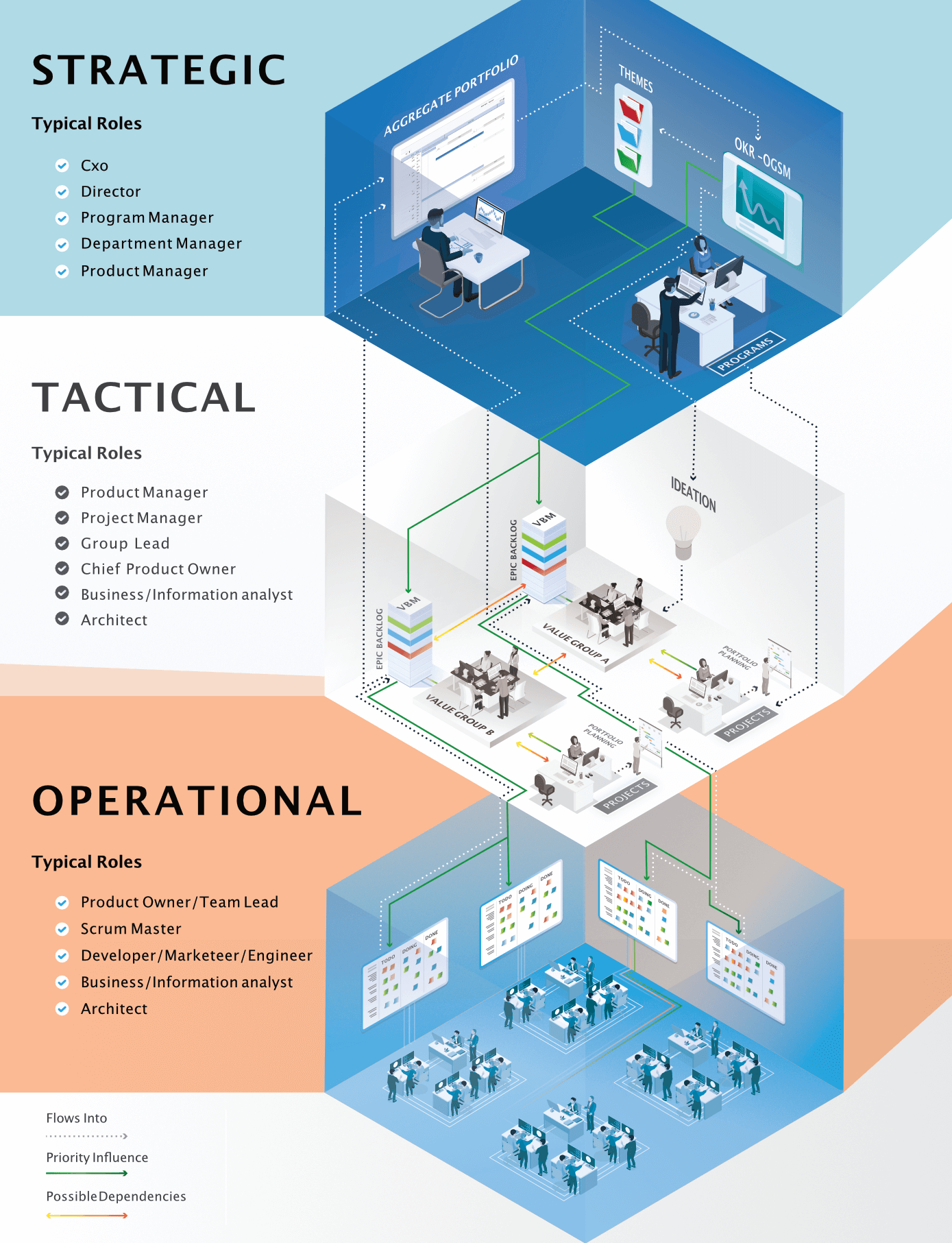
Taskstreamer Framework — Strategic, Tactical, Operational layers
Aggregate Portfolio
Themes
OKR · OGSM
Programs
Value Group
Multiple Value Groups
Projects (Waterfall / Prince2)
Team & Sprint Board
Team & Sprint Board
Teams & Kanban Boards

Tap any element to see how it maps to your organization

🎯
Strategic
CxO · Director · Program Manager · Product Manager
📊
Aggregate Portfolio
Monthly portfolio review - one view across all teams and programs
🎯
Strategic Themes
Yearly theme setting - the priorities that shape everything below
📌
OKR / OGSM
Yearly strategy, quarterly progress — works with any strategic framework
🏗️
Programs
Initiation & detailing - breaking strategy into executable work
⚖️
Tactical
Product Manager · Project Manager · Product Owner · Architect · RTE
⚖️
Prioritization & Backlog
Quarterly configuration, ongoing reordering - what should we build next?
💡
Ideation & Discovery
Ongoing idea intake, org voting, structured evaluation for any team size
🤝
Value Group
Your ART, Department, or Product Area — quarterly alignment, dependency reviews
🔀
Multiple Value Groups
Different groups, different methods - one portfolio view across all
📊
Portfolio Planning
Monthly review with leadership - scenario planning, what-if decisions
📋
Projects (Waterfall / Prince2)
Phase gates, milestone reviews - alongside Agile in one portfolio
💻
Operational
Product Owner · Scrum Master · Developer · Engineer
📋
Sprint Board & Daily Work
Daily standup, sprint planning, retro — the familiar Agile rhythm
🎬
Sprint Demo & Review
Bi-weekly demo to stakeholders - feedback flows back into planning
✂️
Story Refinement & Estimation
Weekly refinement, collaborative estimation - scales from 3 to 30 teams
×

When a priority shifts, the plan should too

Most organizations spend weeks cascading changes through slide decks, spreadsheets, and status meetings. Here is what happens when the three levels are actually connected.

1
Direction

Quarterly Strategy Review shifts a priority

Leadership decides security compliance ships before marketplace. This happens in every organization - the question is what happens next.

📅 Ceremony: Quarterly Progress Review · Strategy App
2
Planning

Feature Plan recalculates across all Value Groups

Priority changes. Every feature in every Value Group recalculates - taking dependencies, team capacity, blocked items, and locked PI Promises into account. Security features rise, marketplace features shift. The roadmap updates itself.

⚡ Automatic: Feature Plan recalculation in <1 second · Jira Plugin
3
Planning

Monthly Portfolio Review reflects the new reality

When Product Managers meet for their review, the roadmap already shows the impact. Which features moved, which objectives are at risk, which dependencies shifted. No manual rebuilding. One live portfolio view across all Value Groups.

📅 Ceremony: Monthly Portfolio Review · Strategy App
4
Execution

Sprint Planning pulls from the updated backlog

When teams sit down for sprint planning, the backlog already reflects the new priorities. Security team features at the top. Platform team sees their dependency is needed sooner. No emergency replanning.

📅 Ceremony: Sprint Planning (bi-weekly) · Jira
5
Execution

Sprint Demo closes the loop

Two weeks later, the demo shows completed security stories. PO/SMs update progress (remaining sprints, blocked items, completed work). Each update recalculates the Feature Plan, which updates the roadmap, which updates the portfolio. The loop closes automatically.

📅 Ceremony: Sprint Demo (bi-weekly) · Jira Plugin
6
Direction

Leadership runs a what-if scenario

Can we ship security faster if we add two FTEs? What happens to the marketplace timeline? Where does a budget cut hurt the least? Management runs the scenario against the live portfolio and sees the impact across every roadmap before committing to the change.

🔮 What-if Scenario Analysis · Strategy App

Fix the connections, and the label on your process becomes almost irrelevant

Every methodology is just a different configuration of the same three levels. See which one matches yours or start a free trial and experience it firsthand.

Start 14-Day Free Trial Find Your Fit
Works with SAFe, Scrum, Waterfall, or your own hybrid · No process changes required