Menu
Implementation Guide

Find Your Fit

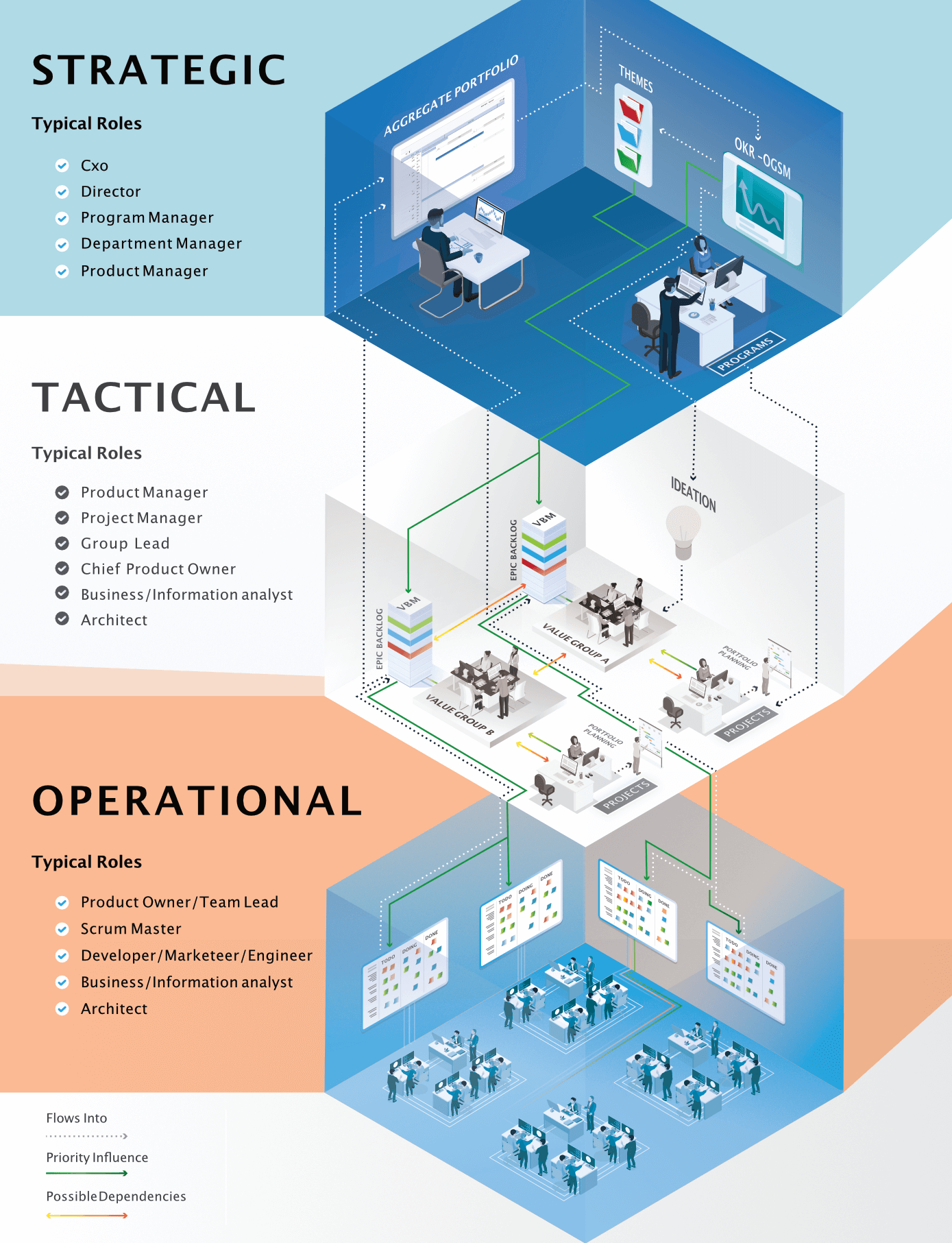
Every organization operates on three levels: direction, planning, and execution. The labels differ and the ceremonies differ, but the structure is always the same. Taskstreamer connects these levels — regardless of which framework you use.

1

Direction

Someone decides what matters. Strategy, OKRs, a program charter — regardless of the label, this is where priorities are set and outcomes defined.

What's more important than what?
2

Planning

Direction becomes a plan of work. Initiatives break into features, features get assigned to teams, dependencies get identified. Every change should recalculate the plan immediately — not next quarter.

When will things land, given reality?
3

Execution

Teams do the work in sprints, iterations, or whatever rhythm fits. Progress feeds back into the plan, which feeds back into direction. A roadmap that doesn't move with reality isn't a roadmap.

What's actually happening on the ground?

Most organizations break at the seams between these levels. The strategy says one thing, the plan says another, and the teams are doing something else entirely. Taskstreamer fixes the connections — so when execution reality changes, the plan updates, and the roadmap reflects it automatically.

Same structure, different configuration

Every methodology is just a different amount of ceremony at each level. Which one sounds like you?

📊

Program / Project-Based

Heavy direction, structured planning with phases and milestones, execution organized around deliverables with estimated durations.

Enterprises, consultancies, agencies, engineering firms

🔄

Agile-ish / Hybrid

Direction from product leadership, planning through initiatives and sprint estimates, quarterly commitments layered on top. The most common configuration.

The majority of companies — Agile teams, traditional reporting

🚂

SAFe

Same three levels with more ceremony around the quarterly commitment — PI planning events, confidence votes, progress tracking against promises.

Large enterprises, regulated industries

Deep Agile / Product-Led

Thin planning layer: features aligned directly to strategy, teams self-organize, the quarterly ceremony may disappear entirely.

Startups, scale-ups, product-led organizations

📊

Program / Project-Based Organizations

Complicated work with known destinations — plan the path, track the phases

You might say:

"We have programs made up of projects"

"Projects have milestones and deliverables"

"We plan in phases, not sprints"

"The project manager owns the timeline"

"We need to see downstream impact when scope changes"

The Three Levels in Your World

Direction Executives → OGSM/OKR program objectives Strategy App
Planning PM → Objectives as project phases, Features as work packages Jira Plugin
Execution Teams → Stories/tasks with iteration estimates Jira Plugin
💡 Project updates have regular cadences — call them iterations, and the language starts looking a lot like sprints. The structure underneath is the same.

Where the Levels Break Apart

"Our project plan in MS Project doesn't match what's actually happening in Jira"
"We discover dependencies between projects too late"
"Executives ask for status and PMs spend a day compiling reports"
"When scope changes, nobody knows the downstream impact until it's too late"

How Taskstreamer Reconnects Them

Automatic Feature Plan: Priority changes, dependency shifts, or blocked items instantly recalculate timelines across all teams
📊
Live Roadmap: Lock the feature map and the roadmap updates itself from execution data — no more manual syncs between plan and reality
🎯
Strategy Dashboard: Executives see program progress linked to execution without opening Jira — always current, never compiled
🔮
What-if Scenarios: Reprioritize, add budget, or set a deadline — see the impact on every project before you commit to the change
🔄

Agile-ish / Hybrid Organizations

The majority of companies — Agile ceremonies with traditional reporting expectations

You might say:

"Teams work in sprints, but we plan in quarters"

"We do PI Planning... kind of... we call it quarterly planning"

"The CPO owns the roadmap, teams own the backlog"

"We're Agile but leadership still needs commitments and dates"

"Our roadmap in slides tells a different story than Jira"

The Three Levels in Your World

Direction C-Suite → OGSM/OKR company strategy Strategy App
Planning CPO → Initiatives per Value Group, Features with sprint estimates Jira Plugin
Quarterly Product + Eng → PI-like commitments, confidence votes Jira Plugin
Execution Teams → Stories in 2-week sprints Jira
💡 The quarterly commitment layer is optional. Keep it open for more flexible planning, or enable PI mode for tighter commitments — Taskstreamer adapts either way.

Where the Levels Break Apart

"Our roadmap slides are outdated the week after we present them"
"Teams commit in quarterly planning but nobody tracks if we hit those commitments"
"Leadership wants dates, Agile says we shouldn't give dates, we end up giving bad dates"
"The CPO's roadmap and Jira tell different stories"

How Taskstreamer Reconnects Them

🔄
Living Roadmap: Each feature update recalculates the plan — the roadmap moves with reality automatically, not via slide decks
📋
Backlog prioritization: Drag to reprioritize features or entire objectives — every reorder instantly recalculates timelines across all teams
📊
PI Progress tracking: Live sprint-by-sprint updates show what's on track, what needs attention, and whether promises will hold
🎯
Strategy-to-Execution bridge: Management sees roadmap progress linked to strategic goals without ever opening Jira
🚂

SAFe Organizations

Formally implementing Scaled Agile Framework — ARTs, RTEs, PI Planning events

You might say:

"We work in Program Increments"

"Features flow through the ART backlog"

"PI Planning is our big alignment event"

"We track PI Objectives and measure business value"

"We need to know which PI promises are at risk before it's too late"

The Three Levels in Your World

Direction Portfolio/LPM → Strategic Themes, OKRs Strategy App
Planning CPO → Objectives per ART, Features with dependencies Jira Plugin
PI Planning RTE + Teams → Confidence votes, PI Promises, committed scope Jira Plugin
Execution Scrum Teams → Stories in iterations Jira
💡 Taskstreamer uses "Value Group" instead of ART — but you can relabel everything. The math underneath doesn't care what you call it.

Where the Levels Break Apart

"PI Planning takes 2 days but our plans break in week 3"
"We don't know which PI Objectives are at risk until it's too late"
"Cross-ART dependencies are managed in spreadsheets"
"Jira Advanced Roadmaps doesn't understand PI boundaries"

How Taskstreamer Reconnects Them

🔒
PI Promises with live tracking: Items promised in a PI stay locked to their planned sprint. When reality pushes them out, ghost bars show the gap — promise percentage updates automatically
📈
PI Progress dashboard: Sprint-by-sprint visibility into what needs updating, what's pushing deadlines, and expected delivery performance at PI end
🔗
Cross-team dependency math: Feature dependencies across teams are calculated, not tracked — blocked items cascade automatically through the Feature Plan
🎯
Confidence + Commitment: PI Plan with confidence votes and stakeholder notes showing what will be delivered and what's at risk

Deep Agile / Product-Led Organizations

Complex work with uncertain destinations — discover the path as you go

You might say:

"We ship small, learn fast"

"The team owns the product"

"Roadmap is a loose direction, not a commitment"

"We prioritize based on impact, not projects"

"We don't need heavy process but we still need visibility"

The Three Levels in Your World

Direction Founders → Lightweight OKRs, product vision Strategy App
Planning POs → Features linked directly to OKRs Jira Plugin
Execution Teams → Stories, continuous flow Jira
💡 Thinnest planning layer — no heavy Initiative/Objective layer needed. POs define features directly aligned to strategy. The Feature Plan still calculates automatically.

Where the Levels Break Apart

"We're small but growing, and we're starting to lose visibility across teams"
"We don't want heavy process but we need to know when things will ship"
"Dependencies between teams are in people's heads"
"Investors/board want a roadmap but we hate maintaining slide decks"

How Taskstreamer Reconnects Them

🪶
Minimal input, maximum output: Teams set sprint estimates and dependencies per feature via a simple Jira widget — the Feature Plan does the rest
📊
Auto-generated roadmap: Keep the plan open for flexible Agile planning — the roadmap moves with the work automatically, no maintenance needed
🔮
What-if for growing teams: Where does adding an FTE have the most impact? Where does losing one hurt the least? Run the scenario before making the call
🎯
Board-ready visibility: Strategy dashboard connects OKRs to execution progress — always current, never a stale slide deck

Quick Recognition Guide

Listen for these phrases to identify your configuration — larger organizations often have multiple

If you hear yourself saying... You're probably...
"We have a PMO" / "Projects have phases" / "We use MS Project" Program/Project
"We do sprints but leadership wants dates" / "Quarterly planning" Agile-ish / Hybrid
"We have ARTs" / "We do PI Planning" / "We follow SAFe" SAFe
"We ship continuously" / "Teams are autonomous" / "Roadmaps are loose" Deep Agile
"Some teams run projects, others do sprints" / "It depends on the department" Multiple

Taskstreamer speaks your language

The words are different but the structure underneath is the same — configure labels to match your framework

Taskstreamer default Your Term
Value Group ART, Train, Domain, Program, Value Stream, Department
Objective Initiative, Epic, Project, Theme, Program Objective
Feature Feature, Work Package, Deliverable, Capability
Team Scrum Team, Squad, Pod, Crew
Sprint Sprint, Iteration, Cycle
PI Program Increment, Quarter, Release Train
CPO Chief Product Officer, VP Product, Head of Product, Product Director
RTE Release Train Engineer, Program Manager, Delivery Lead, Agile Program Manager
PO Product Owner, Product Manager, Feature Owner, Business Analyst
SM Scrum Master, Agile Coach, Team Coach, Delivery Manager, Iteration Manager
Fix the connections, and the label you put on your process becomes almost irrelevant

Let's walk through your setup together

Start 14-Day Free Trial Book a Demo
30-minute call to discover Taskstreamer for your workflow