Trust Center
Trust is built in, not bolted on.
Conductor lets your teams work with AI while you stay in control: your models, your rules, your approval before anything changes.
1
Your models, your choice.
Cloud or local, under your own contract with your provider.
2
Your registered keys never reach the AI model.
Held in a vault and added to calls only after Conductor checks them.
3
Nothing irreversible without approval.
No merge, release or external change until a person, or a rule you ratified, approves it.
4
Everything recorded.
Every model call, action, run and approval, in a tamper-evident record.
5
Built and hosted in the EU.
In the Netherlands.
Every claim on this page has a status. Conductor is new, so we tell you what exists today and what comes next.Available Planned
01 · Staying in control
People decide. AI does the work.
AI does the work. People decide what is worth doing and whether the result is right.
Approval before releaseAvailable
Gates stop work that fails a check until a person clears it, with a reason. Release rules your organisation ratified decide what happens at a release stop: go ahead, or wait for a person. A rule never releases anything external and irreversible on its own.
Separation of dutiesAvailable
Where your Workspace requires it, the person who started the work cannot be the only one to release it.
LiveAvailable
See all AI work running right now across the Teams of a Workspace, with a stop on every row. Stop one run, a Team or a whole Workspace from the same screen; each stop asks for a reason.
PlannedPausing a run from the same screen.
The action guardAvailable
Your own trusted model watches what the AI does and can halt the work for a person. It can never approve anything.
Steering during the workAvailable
When the AI asks a question or a step is held, a person answers or decides before the work goes on, not only at the end.
PlannedRedirecting the AI while it is working.
Strict and explore modesPlanned
Strict for work that will ship; explore for prototypes that never release anything.
02 · Security architecture
Built so that a mistake cannot travel far.
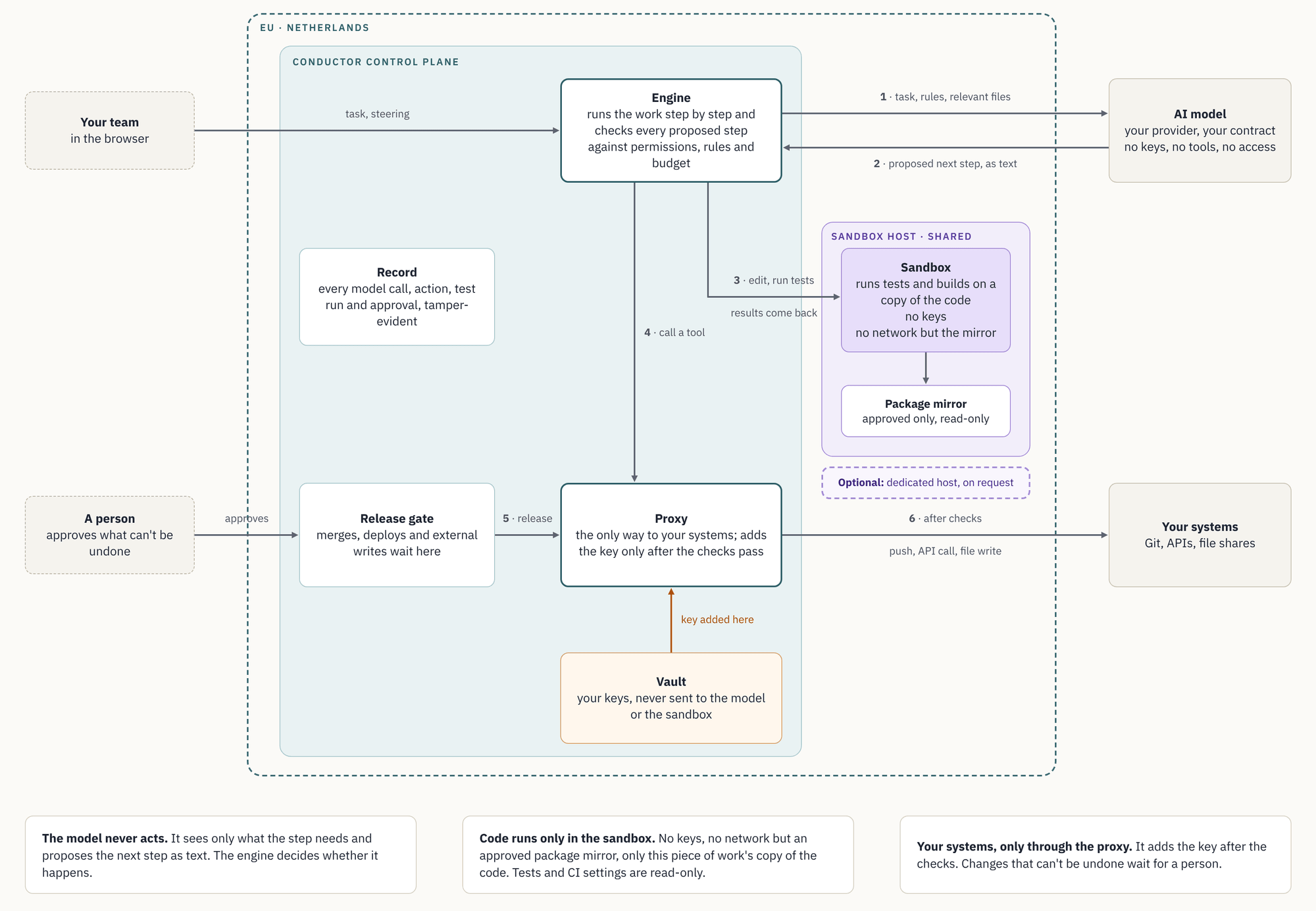 Open the diagram full size ↗
SandboxesAvailable
Code the AI writes runs only in a governed sandbox (NVIDIA OpenShell), never on our control plane: no credentials inside; no network access except a package mirror; tests and CI configuration read-only; CPU, memory and time limits per run; a hard stop within seconds.
CredentialsAvailable
Keys you register in Conductor are held in a vault. Conductor adds them to the calls the AI proposes, after checking each call. They never appear in a prompt, a model response or a sandbox.
PlannedRemoving secrets from tool output before the model sees it.
Tenant isolation, in three layersAvailable
1. Data separated per tenant at the data layer. 2. Encryption keys per tenant for record content. 3. A separate sandbox for every run, with no credentials inside; a dedicated sandbox host per customer on request, at extra cost.
EncryptionAvailable
Mutual TLS between the control plane and sandbox hosts, and to the package mirror. Sandbox volumes are encrypted per customer, and so are the recorded inputs, under a key per tenant.
PlannedTLS between the internal services, and encryption at rest for the main databases.
Identity and accessAvailable
Single sign-on and multi-factor authentication. Permissions are granted at the exact scope (Workspace, Project, Module, Team), never broader.
DetectionPlanned
Tripwires (decoy routes, paths and values no legitimate work touches) stop the work on contact. Security events stream to your SIEM.
What the AI can reachAvailable
Only the systems and operations your organisation and Team have authorised, per skill, Module and Team. Everything else is refused and recorded.
03 · AI-specific risks
The risks that come with AI, and what stops them.
Risk
How Conductor handles it
Prompt injection (instructions hidden in code, documents or web pages)
How Conductor handles itThe AI can only reach what it is authorised for; the sandbox has no network; the action guard watches for the AI following injected instructions; nothing irreversible without release
Data leaving through the AI
How Conductor handles itNo network in the sandbox; web access goes through Conductor and is checked against the data’s sensitivity; each model has a sensitivity ceiling
Model errors and hallucinations
How Conductor handles itGates, independent verification of tests, acceptance criteria checked by the engine, human review before release
The AI touching what it shouldn’t
How Conductor handles itPermissions per skill, Module and Team; protected files locked twice (engine and sandbox); tripwires
The AI weakening its own tests
How Conductor handles itTests and CI configuration are read-only and checked against the base before anything lands
Runaway cost or endless loops
How Conductor handles itBudgets per Team and Thread; loop detection that escalates to a stronger model or a person
A weak model producing poor work
How Conductor handles itEvery model is benchmarked on your kind of work before it may do agent work; quality per model is visible on the dashboard
04 · Your data
Your data stays yours, and stays in the EU.
Where it lives
Conductor will run on Cyso Cloud in the Netherlands, where the rest of Taskstreamer already runs.
Where model traffic goes
To the model provider you choose, under your own contract with them. Taskstreamer does not route your work through a model account of its own.
No training on your data
Taskstreamer does not use your content to train models.
PlannedAn optional model per organisation that learns from how your own Threads progressed, not from their content, which Threads may need rework, and brings those to a person sooner. Off by default, and it never approves anything.
Export and leavingAvailable
Administrators can export the audit trail, including its hash chain, as JSON or CSV, as well as a Team's Threads as CSV and a person's personal data.
PlannedA full export of your record and content in open formats, with a documented exit procedure.
Platform mode and connected mode
Plannedconnected modeTeams can run AI work inside Conductor, or use their own coding agent and connect it to Conductor. Here is exactly what Conductor controls in each.
Platform mode
Connected mode
Where the AI works
Platform modeConductor’s sandbox, EU-hosted
Connected modeThe developer’s own machine
Which model sees your data
Platform modeThe endpoint you registered, within its sensitivity ceiling
Connected modeThe developer’s coding agent, on your organisation’s plan with that provider
Credentials
Platform modeNever near the AI
Connected modeConductor-registered keys never reach the AI; the developer’s machine is outside Conductor’s control
Control before each action
Platform modeEnforced
Connected modeCooperative (hooks); unreported changes are flagged
Release and merge
Platform modeEnforced
Connected modeEnforced
Independent verification
Platform modeEnforced
Connected modeEnforced
Record
Platform modeComplete
Connected modeDecisions complete; actions as reported, and labelled as such
In connected mode, control moves from each action to the push. Nothing lands without approval in either mode.
05 · The record and audit
A record you can check, not just trust.
Append-only and hash-chainedAvailable
Every entry in a Thread's record is linked to the one before and signed, and the record store only accepts new entries, so any change is detectable.
Nightly integrity checksAvailable
Verify the chain and replay key decisions.
For auditorsAvailable
Exports of the audit trail for your administrators.
PlannedTime-limited guest access for auditors to the record and its exports, itself recorded.
Independent verificationPlanned
External anchoring of the record and an open-source offline verifier.
06 · Reliability
Built to pause, not to lose work.
Availability targetAvailable
99.9% per month.
Backups and recovery
Daily backups. Recovery target: within 12 hours.
During an outageAvailable
Running AI work resumes from the record afterwards, at the step that was interrupted. Nothing is lost, and an action in the outside world is never sent twice.
07 · What Conductor does not do
We’d rather tell you the limits than have you find them.
- AI still makes mistakes. Conductor makes them visible and stops them before release, not before they happen.
- The action guard detects some prompt injection and model errors. It does not prevent them. Prevention comes from permissions, the sandbox and release.
- In connected mode, Conductor does not control the developer’s machine or what their coding agent sends to its model. It controls what lands.
- Sandboxes of different customers can run on the same host. Every run gets its own sandbox, and no credentials ever exist on the host, so a sandbox that breaks out finds no keys. If you want a host of your own, a dedicated host is available on request, at extra cost.
- Conductor does not replace your compliance programme. It produces evidence for it.
08 · Contact and documents
Everything your security review needs.
Security contact
Responsible disclosure policy and security.txt.
Bring your security team.
Walk through the architecture, the record and the limits with us, on your own questionnaire if you have one.