From direction to delivery. 3 products 1 connected system.
1. Strategy sets direction. 2. Blueprint turns it into a plan that recalculates itself. 3. Conductor is where teams and AI do the work.
One engine connects all three, so a decision at the top reaches every team.
Layer 1 of 3
1 Direction · Taskstreamer Strategy
Set direction your teams can actually follow.
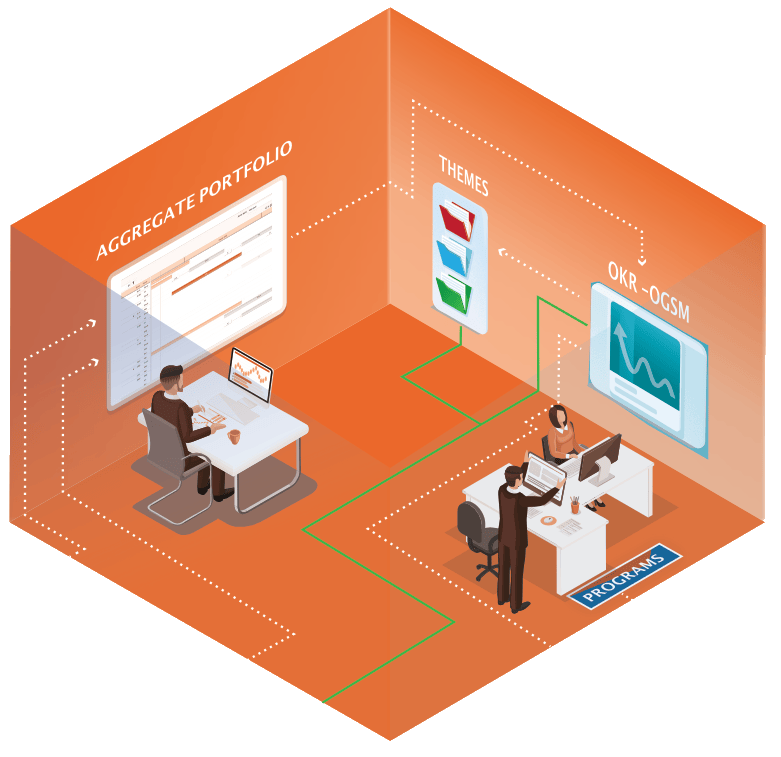
Strategy holds your goals in OKR or OGSM and cascades them to the teams. It combines every value group into one roadmap, and lets you test a decision before you make it.
For you if: your teams are busy, but you cannot see whether that work moves the goals.
What you get
1
Know where your teams' effort goes
See every initiative against the goal it serves, across all value groups. Work that serves no goal stands out.
2
Decide before you commit
Test a new priority, more or fewer FTEs, or a deadline and see what moves before you announce it.
3
One version for board and teams
Goals, roadmap and progress come from the same data. No separate slide decks to keep in sync.
What's inside
✓OKR or OGSM, cascading down to the teams
✓One roadmap across all value groups
✓What-if analysis: a new priority, more or fewer FTEs, or a deadline
✓Create demand as programs and epics, and manage work that spans departments
✓Strategic target dates shown on the implementation roadmap
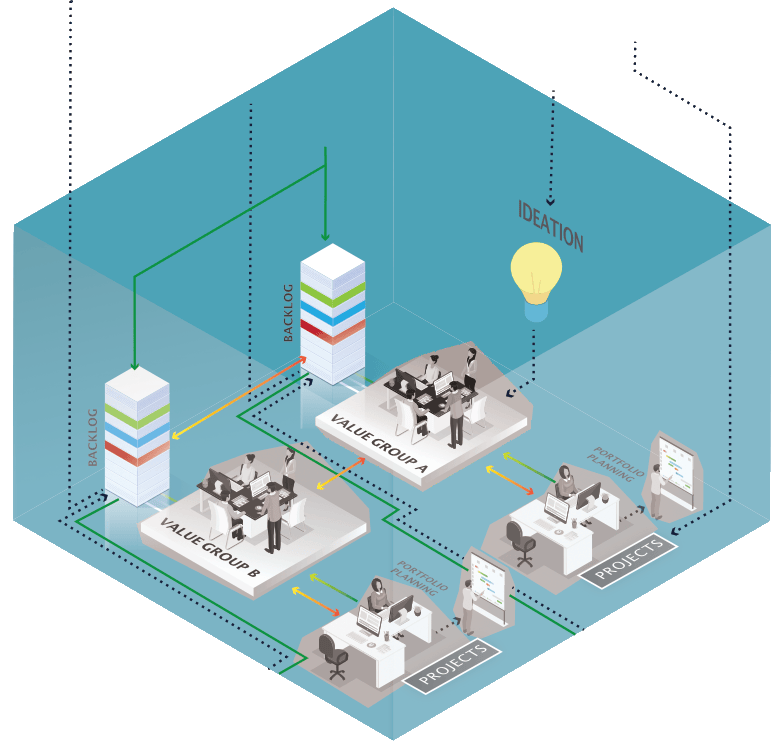
Blueprint is the engine that turns priorities, capacity and dependencies into a plan per team. Change one priority and every affected date moves with it, across teams.
For you if: your plans are out of date as soon a priority changes and needs multiple meetings to fix.
What you get
1
Dates you can defend
Delivery dates are calculated from priorities, capacity and dependencies. You can show why a date is what it is.
2
Change course without replanning
Move one priority and every affected date moves with it, across teams. The trade-off is visible at once.
3
See the collision before it happens
Dependencies between teams, including teams in Jira, show where one delay will hit another team.
What's inside
✓From automated roadmap per value group, to backlog and calculated feature plan per team
✓Dependencies across all teams, including ones in Jira
✓Challenge priorities, and resolve disagreements with the Value Bucket Model
✓See what a priority change does to every timeline before you push it
✓Automated sprint schedules: every update replans all teams and their dependencies
✓Optional SAFe Program Increment support, with progress reporting and alerts when you need to act. Switch it on when you need it
✓Built into Conductor, and available in Jira as a plugin (Blueprint in Jira)
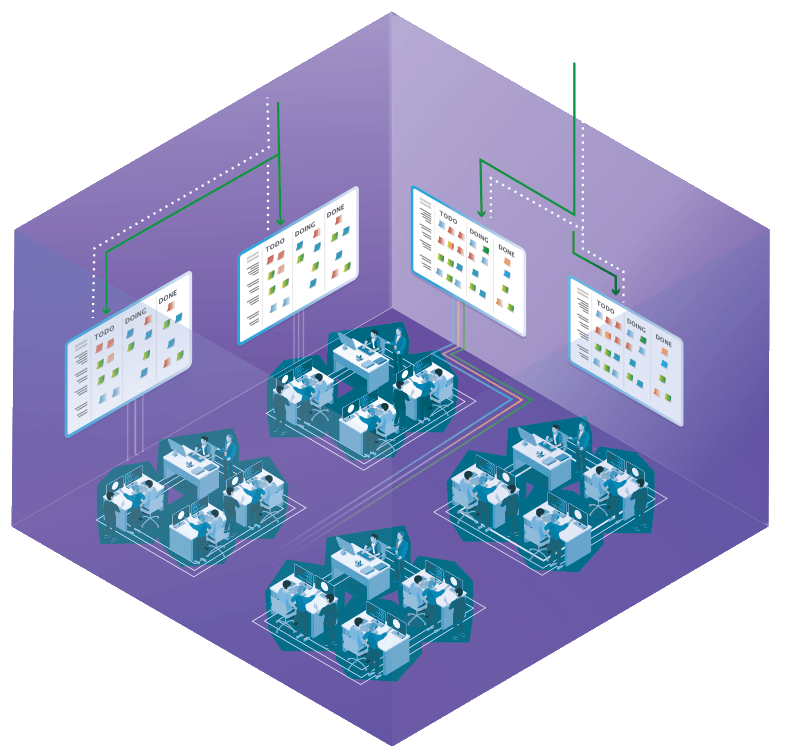
Conductor gives every team one shared context. People set direction, AI works within your guardrails, and a person approves what ships. Planning is built in.
For you if: your team uses AI, but each in their own chat, and nobody can see or check what it produced.
What you get
1
Context nobody has to repeat
Each thread builds on earlier work, decisions and rules. The AI and new colleagues start informed, not from zero.
2
Review what matters, not everything
Guardrails check every result. Your people spend review time where it counts, not on every line.
3
Use AI and still answer for the result
Your models, your rules, a person approves, and everything is recorded. You can show who decided what, and why.
What's inside
✓Shared context that builds up across projects, threads and teams
✓Guardrails per project and module, as detailed as you need
✓Human approval and a complete record of what the AI did, for code, documents or any other digital work
✓Your own AI models, in the cloud or on your own hardware
✓Live: see every AI run as it happens, and pause or stop it
✓Your own trusted model watches what the AI does and can halt the work for a person. It can never approve anything
✓Work that leaves Conductor needs release by a person or a rule you agreed
✓Keys you register in Conductor never reach the AI model
Used by
Team ownerProduct ownerDeveloperMarketeerEngineerAnalyst
Every thread of work traces back to a strategic goal. No copy and paste between tools, and no status reports to stitch it back together.
1 · Direction
Strategy
Set objectives and group the work into epics and programs.
2 · Planning
Blueprint
Value groups turn epics into initiatives and features. Roadmaps update by algorithm.
3 · Execution
Conductor
Teams deliver threads in a project module, with AI agents under human approval.
OKR / OGSM
Objectives and the measures that track them.
Epic / Program
Strategic bets, linked to objectives.
becomes
Initiative
Planned in one value group, linked to epics.
Feature
Concrete scope, delivered by one or more teams.
runs as
Team
Who does it
Module
Where it lands
Thread
One unit of work: one feature, one team, one module.
1 · Direction
Strategy
Set objectives and group the work into epics and programs.
OKR / OGSM
Objectives and the measures that track them.
Epic / Program
Strategic bets, linked to objectives.
Each epic becomes initiatives in a value group
2 · Planning
Blueprint
Value groups turn epics into initiatives and features. Roadmaps update by algorithm.
Initiative
Planned in one value group, linked to epics.
Feature
Concrete scope, delivered by one or more teams.
Each feature runs as threads, per team and module
3 · Execution
Conductor
Teams deliver threads in a project module, with AI agents under human approval.
Team
Who does it
Module
Where it lands
Thread
One unit of work: one feature, one team, one module.
Start with Conductor for one team, with planning included. Add Strategy when you want every team connected to where the company is heading. Teams still in Jira join the same plan through Blueprint via the Jira plugin.
Start with one team. Grow from there.
Try Conductor with your own team and your own models, or take thirty minutes with us and see the whole platform on your own work.
We use cookies to improve your experience, analyze site traffic, and for marketing purposes. By clicking "Accept", you consent to our use of cookies. Learn more
 Layer 1 of 3