Execution · Taskstreamer Conductor

Where teams and AI
do the work, together.

Every piece of work is a thread: one feature, one team, one module. People decide what is worth doing, AI works within your guardrails, and a person approves what ships. Everything is on record.

Start free trialBook a demo

30 days free. No credit card needed. Planning included.
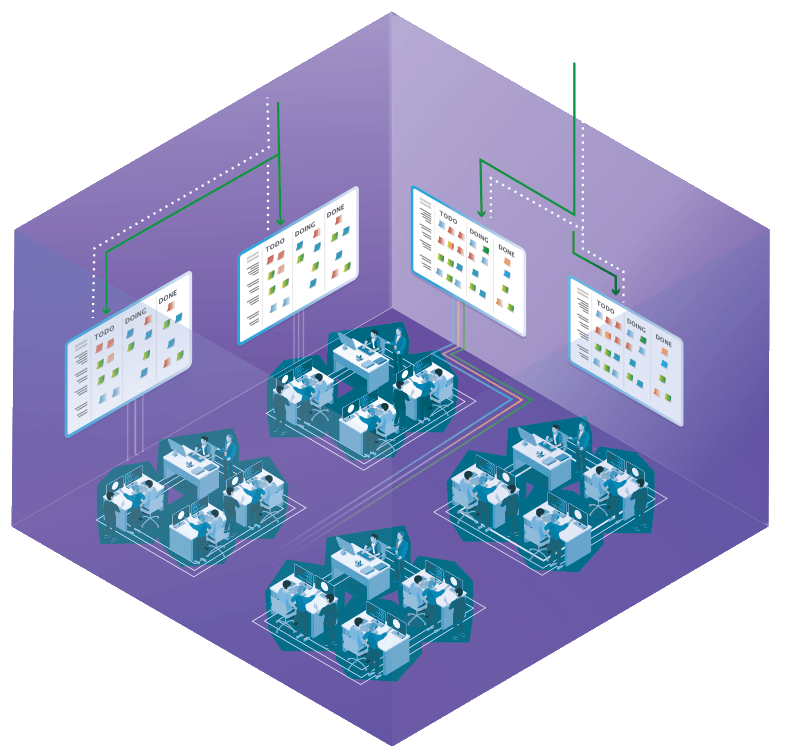
Execution floor: teams at work
Your own models
cloud or your own hardware, your keys
Your guardrails
per project and module, as detailed as you need
Your approval
nothing irreversible ships without it
How it works

One shared workspace for your team and AI.

Conductor takes the work from the plan to release. Use as much AI as you want, or none at all: teams can also run their sprints in Conductor the way they did in Jira.
Plan
From feature to threads.
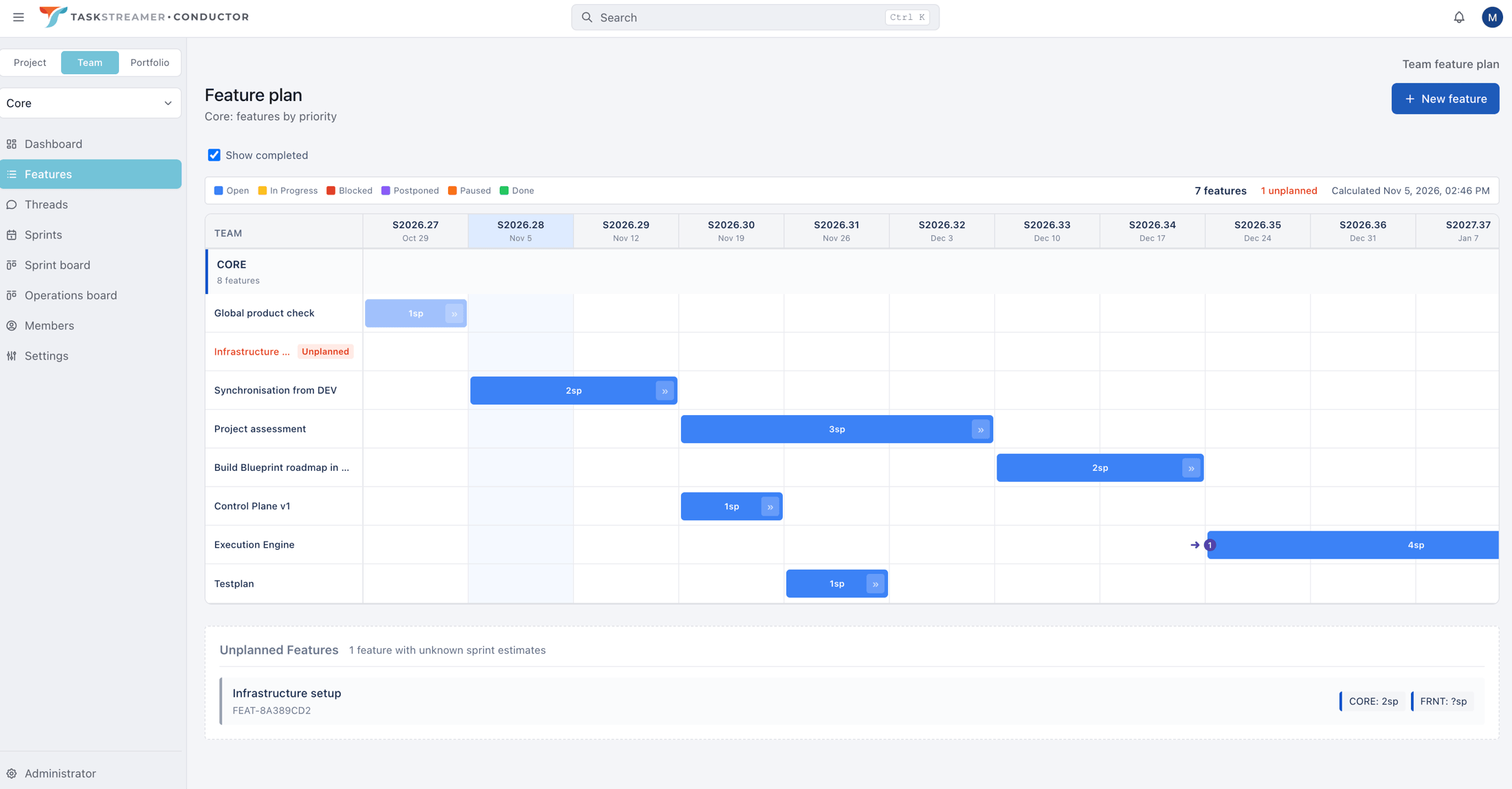
A team takes features from the plan and refines them into threads, with AI helping if you like. Each thread is one unit of work: one feature, one team, one module. Sprints for planned work, an operations board for the work that never stops.
Feature plan of a team in Conductor: features in priority order across the coming sprints
1 / 4
Guardrails

Hundreds of rules. Each step gets the ones it needs.

Large rulebooks usually drown an AI model, or cost a fortune. Conductor indexes your guardrails, so every step receives only the rules that apply to it. Results get better, model costs stay down, and you can search exactly which rule applies where.

Software development
Functionality, architecture, security posture, coding posture, test posture
Marketing
Brand identity, brand book, colour scheme, communication style
Your workspace
Define the guardrail types your work needs

Project rules apply everywhere; module rules add detail. Where they differ, the project wins.
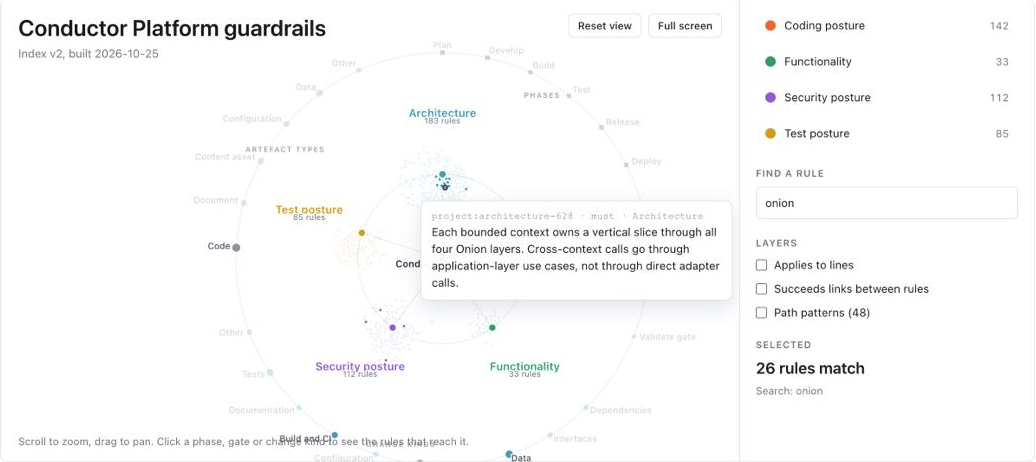
Guardrail graph of a project with 555 rules, searching for a rule about onion layers

555 rules across five types, and one found by searching.

Start from what you already have.
Connect an existing repository or file share to a module and let AI assess it against your guardrails. Gaps show up in both directions: work that is missing, and rules that no longer match reality. Each gap can become a thread.
The execution engine

More than a shared IDE for AI. The model proposes, the engine decides.

In an AI coding tool, the agent acts and someone checks afterwards. In Conductor, the engine runs the work, not the model. Every action the AI wants to take is checked against your rules before it happens, and the result is recorded.

1
The model proposes
It suggests the next action: read, search, edit, run a command, call one of your systems. A suggestion, nothing more.
2
The engine checks
Is this within reach of the skill, module and team? Is this path allowed? Is there budget left? Is a stop active? Same rules, same answer, every time.
3
It runs in a sandbox
Commands and tests run on a separate host: no keys, no network beyond a package mirror, your tests and CI configuration locked.
4
Gates check the result
AI review first, then a person. A model never marks its own work as passed, and people tick off the acceptance criteria.
5
People release
Anything that cannot be undone or leaves your organisation, such as a push, a merge or a deploy, waits for a person or a rule you ratified.

A failed check or a rejected review sends the work back into the loop, within the team’s budget. The budget is checked before every model call.

How this differs from personal AI agents →
Rules are written down, not learned
What the AI may do is set in rules you can read and change. No model decides what is allowed, and nothing in the engine is trained.
Freedom follows the action
Reading and editing inside a sandbox can run on its own. Whatever cannot be undone, or reaches outside, waits. It is a property of each action, not one switch for the whole company.
Replay any run, without the AI
The record holds every proposal, check and decision. A run can be replayed from it without calling a model, so you can see exactly why each step was allowed.
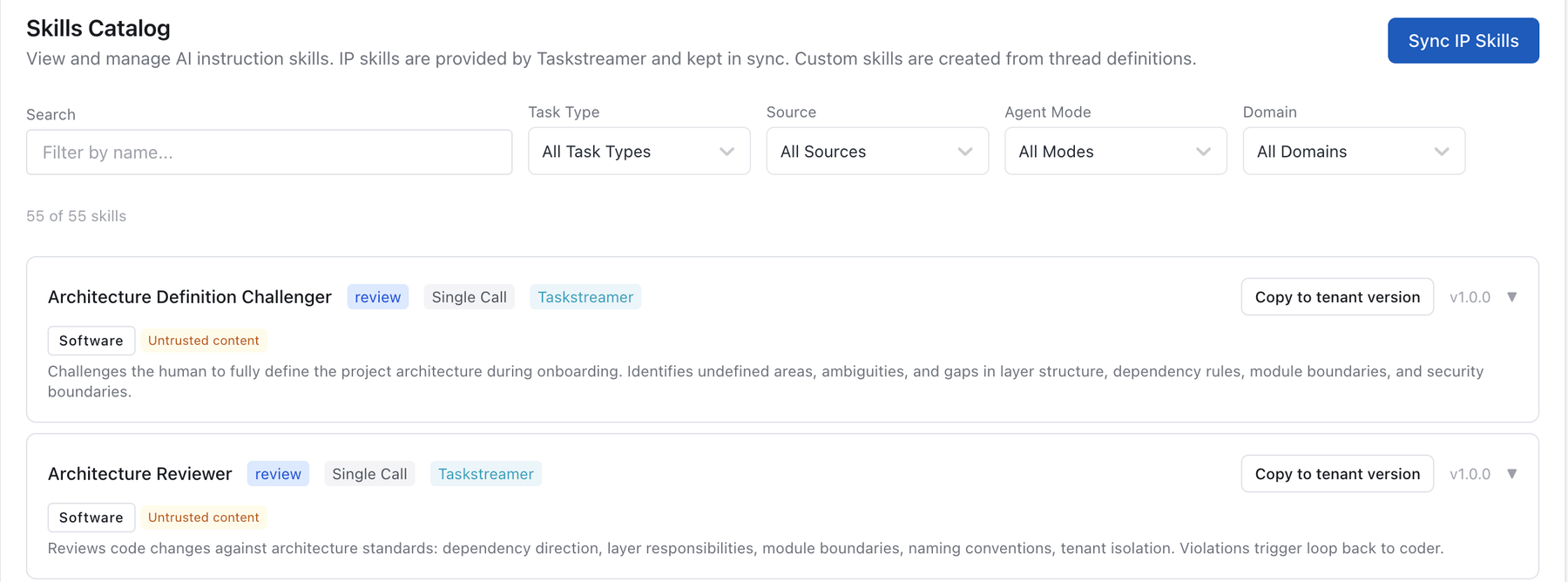
Skills catalogue in Conductor's administrator settings, with Taskstreamer skills that can be copied to a tenant version

The skills catalogue: Taskstreamer’s skills, kept in sync, and your own versions.

Skills your teams can read
Each phase of a thread uses skills: plain-language instructions with a policy the engine enforces. Start from Taskstreamer’s set, copy one to make it your own. Skills are versioned, approved and adopted per team, and a skill can only narrow what the workspace allows, never widen it.
Models that qualify for the work
Every model you register is tested on your own endpoint against Taskstreamer’s qualification suite. Only models that pass the bar for a skill or phase do loop work. The others handle single tasks, such as reviews and summaries.
Control

AI does the work. People stay in charge.

While the engine checks every step, people see the work live and make the calls that matter. When something looks likely to need rework, it reaches a person early.

✓
Approval before release
Nothing irreversible, such as a merge, a release or a change in another system, happens until a person or a rule you agreed releases it.
✓
Separation of duties
Where you require it, the person who started the work cannot approve it.
✓
Live
See every piece of AI work running right now, with pause and stop on every row, or stop a whole team at once.
✓
Action guard
Your own trusted model watches what the AI does and can halt the work for a person. It can never approve anything.
✓
Your keys stay yours
Keys you register in Conductor never reach the AI model. Conductor adds them to the calls it has checked.
✓
A complete record
Every prompt, action, review and approval is kept in the thread, ready for your auditor and the EU AI Act.
How it works in detail, in the Trust Center →
Fits your organisation

Built for how teams really work.

Not only for developers
Workspaces for software, marketing, finance or HR, each with its own phases, skills and guardrail types. Outputs land in the module’s own repository or file share: code, campaigns, contracts.
Your models, your budget
Choose which models each team may use. Every team gets an AI budget per sprint, and asks for more when it needs it, with an approval.
Roles that fit your organisation
Give people a role per workspace, value group, project, module or team. Call your roles and terms what you call them: a product owner can be a delivery manager.
Planning is built in. Roadmap, initiative refinement, priorities and the calculated feature plan from Blueprint, all inside Conductor. When a sprint closes, the feature plan updates itself.
Blueprint for Planning →

Bring your team. Keep your AI.

€9 per user per month billed yearly, or €12 billed monthly. Planning included. 30 days free, no credit card needed. See pricing

Start free trialBook a demo